
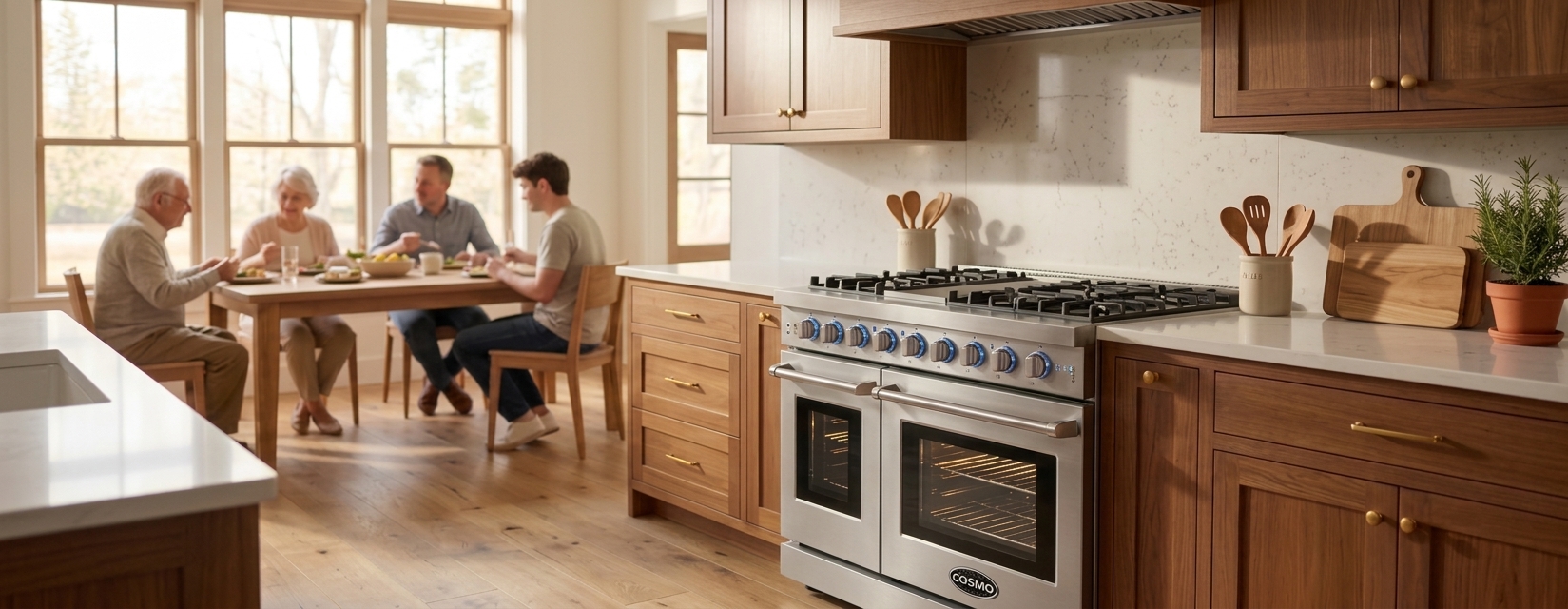
Designing a Kitchen for Three Generations Under One Roof
A Kitchen Built for More Than One Household’s Habits
Walk into a growing number of American homes right now and the kitchen is doing a job it was never really designed for: feeding, and functioning for, three generations under one roof at the same time. A grandparent managing reduced mobility, parents juggling work schedules and school lunches, and adult children who moved back home or never left are all sharing the same counters, the same stovetop, and the same handful of peak cooking hours. That is not a temporary arrangement for a shrinking number of households. It is the new normal for a significant and growing share of American families, and it is starting to change what a well-designed kitchen actually needs to do.
The Numbers Behind the Shift
Multigenerational home purchases reached an all-time high in 2024, according to the National Association of Realtors, with 17 percent of all homes purchased that year going to multigenerational households, a figure that has climbed steadily for more than a decade. The generational breakdown tells its own story about who is driving this shift: 21 percent of Gen X buyers purchased a multigenerational home in 2024, nearly double the 12 percent recorded in 2013, while older millennials rose from 9 percent in 2018 to 12 percent in 2024. These are not outlier households. They are a fast-growing, mainstream segment of the housing market.
The reasons behind the trend are practical rather than sentimental, even when the outcome brings families closer together. Cost savings were cited by 36 percent of multigenerational buyers in 2024, more than double the 15 percent who said the same in 2015. Twenty-one percent pointed to adult children moving back into the house, up from 11 percent a decade earlier, and 20 percent said adult children or relatives simply never left home in the first place, compared to just 7 percent in 2015. Eldercare adds another layer entirely: 35 percent of older millennial buyers specifically cited health and caretaking responsibilities for aging parents as a reason for the purchase. A household built around these realities is not a household that can plan its kitchen the way a single-family, single-generation home always has.
Why the Standard Kitchen Layout Breaks Down
Most kitchen design guidance, the work triangle between sink, stove, and refrigerator, a single primary cook zone, one oven sized for one household’s typical meal, was built around the assumption of one or two people cooking for a household of a fairly consistent size and set of needs. A multigenerational kitchen breaks nearly every one of those assumptions at once. There may be two or three people who consider themselves the primary cook, each with different schedules, different dietary needs, and different comfort levels with a stove. A grandparent managing arthritis or reduced vision needs different reach heights and control interfaces than a teenager cooking a quick meal between activities. A household preparing dinner for six or seven people, several nights a week rather than occasionally, is running its kitchen at a sustained capacity that a standard single-family layout was never sized for.
The result, in a lot of homes that have not adjusted, is a kitchen that becomes a bottleneck rather than a gathering space: one person waiting on the oven while another needs the stovetop, someone reheating a plate because dinner ran in shifts, or a family member who genuinely cannot reach or safely operate part of the kitchen without help. None of that is a design failure specific to any one family. It is what happens when three generations’ worth of needs get routed through equipment and a layout sized for one.
The One Appliance Decision That Solves the Most Common Bottleneck
Of everything a multigenerational household can change about its kitchen, the single highest-impact decision is usually the simplest to name and the easiest to overlook while planning a renovation: whether the household has enough oven capacity for more than one person to cook a full, independent meal at the same time. In a single-generation household, one oven cycling through a single family’s dinner is rarely a problem worth solving. In a household where a grandparent eats on a different schedule, at a different temperature preference, or with different dietary needs than the rest of the family, and where a parent is also trying to get a weeknight meal on the table for kids on their own timeline, a single oven turns into the daily chokepoint that everything else in the kitchen has to work around.
Cosmo’s COS-30EDWC, a 30-inch double electric wall oven, is built around exactly that problem. It has two full 5-cubic-foot cavities, upper and lower, each running its own temperature and cooking mode completely independently of the other. That means a grandparent’s dinner can go in an hour earlier at a gentler temperature in one cavity while the rest of the household’s meal is still being prepped in the other, without either person waiting on the other or negotiating a shared setting. Seven cooking functions per oven, including bake, broil, warm, proof, convection bake, convection broil, and convection roast, give each generation’s cook genuine flexibility rather than forcing everyone toward the same recipe just because they share one appliance.
The details built into that capacity matter more in a household running the kitchen at higher, more varied capacity than a typical home. Both ovens run Turbo True European Convection, a fan-assisted system that distributes heat evenly and, according to the manufacturer’s testing, cooks roughly 25 degrees cooler and about 10 percent faster than a conventional oven, which shortens how long the kitchen is occupied on a night when two different meals are running at once. A built-in temperature probe in the upper oven takes the guesswork out of a dish that has to come out exactly right, especially useful when a household is timing a shared meal around multiple schedules. A self-cleaning function, delay start, and a hidden bake element handle the maintenance side of an appliance that a single-generation kitchen might use once or twice a week and a multigenerational one is running most days.
The larger point is not that every multigenerational household needs a double wall oven specifically. It is that identifying the one piece of equipment actually causing the daily bottleneck, and solving that first, does more for how a shared kitchen functions than a long list of smaller updates spread across the whole room. For a lot of households juggling more than one cook and more than one schedule, that bottleneck is the oven, and a genuine second cavity, not a smaller secondary appliance bolted on as an afterthought, is what actually removes it.
Designing the Rest of the Kitchen Around How It Is Actually Used
Once the core cooking bottleneck is addressed, the remaining decisions are less about any single appliance and more about how deliberately the space accounts for who is actually using it. Reach heights and control interfaces matter more than in a single-generation home, since a layout that works fine for a standing adult of average height and full mobility may quietly exclude a grandparent who should not be reaching overhead or a younger family member not yet tall enough to safely reach a shelf. Thinking in zones, rather than one shared workspace, helps too: a dedicated area for a grandparent’s routine, enough counter space that two people prepping at once are not working shoulder to shoulder, and storage placed with an honest sense of who needs to reach what, all reduce the daily friction that builds up in a kitchen running at sustained, higher capacity than a standard household. None of this requires a larger footprint so much as a more deliberate one, planned around the people actually using the space, rather than a single idealized cook working alone.
A Kitchen That Fits the Household Living In It
The multigenerational household is not a passing arrangement or a temporary compromise for the families choosing it. It is a durable, fast-growing share of how Americans are choosing to live, driven by economics, caretaking responsibilities, and family circumstances that show no sign of reversing. A kitchen designed around one cook, one schedule, and one set of physical abilities was never going to serve that household well, no matter how much square footage it had. The households getting this right are usually the ones who identified their actual daily bottleneck, most often the oven, and solved it with real, independent capacity rather than working around it indefinitely. Getting that one decision right is not a luxury upgrade. For a growing number of American households, it is simply what a functional kitchen looks like now.