
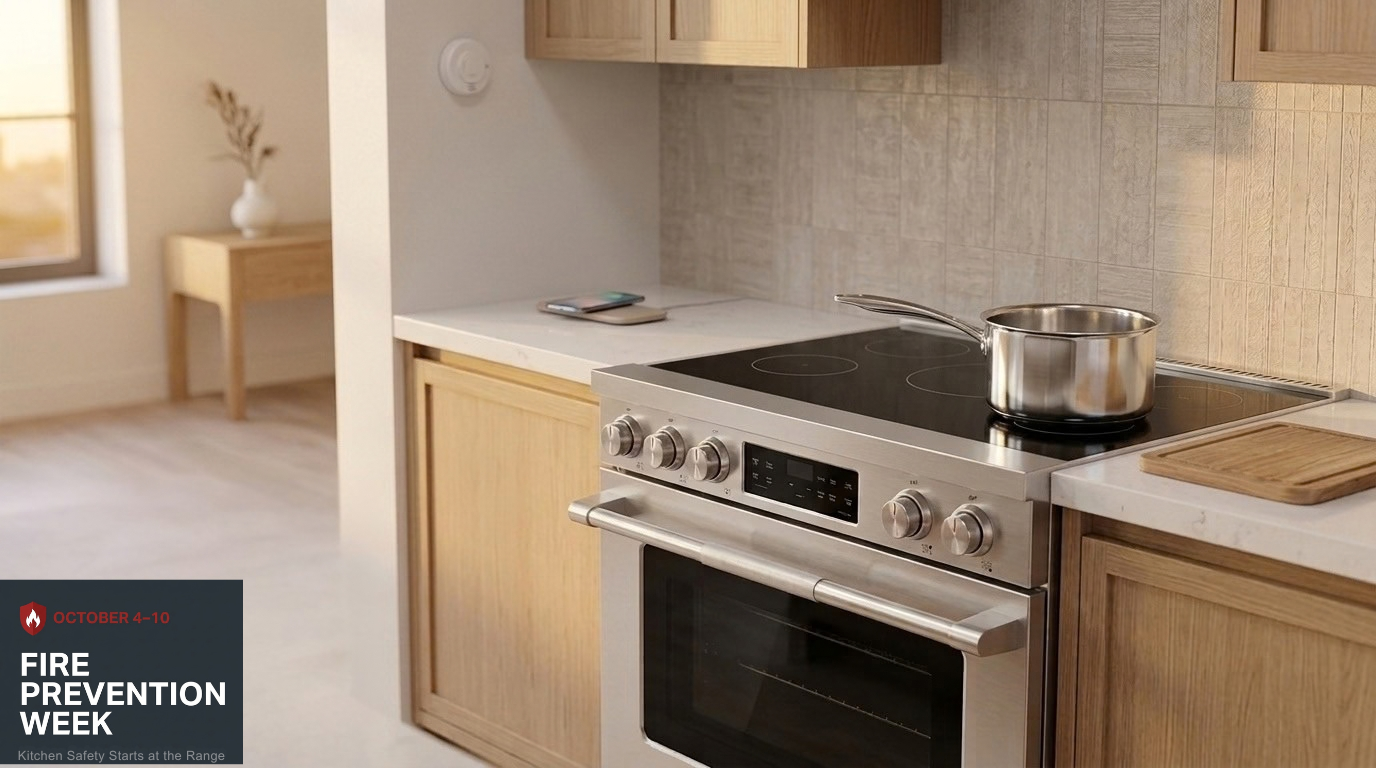
Fire Prevention Week Starts in the Kitchen, and the Safest Habits Begin at the Range
Every October, the National Fire Protection Association asks the country to spend a week thinking about something most households would rather avoid: how a fire actually starts. Fire Prevention Week runs October 4 to 10 this year, timed around the anniversary of the Great Chicago Fire of 1871, and it is one of the longest running public safety observances in the United States. This year’s theme, Charge into Fire Safety: Safe Charging Is a Superpower, puts the spotlight on lithium ion batteries, the rechargeable power source inside phones, tablets, laptops, cordless tools, and a growing list of small kitchen devices.
A week about charging might not sound like a kitchen story, but the kitchen is where fire safety and daily life overlap the most. It is where dinner simmers, phones charge on the counter, and a tablet propped against the backsplash walks someone through a recipe. Cooking is also the leading cause of home fires in the country, which makes this the right week to look at the room with fresh eyes, especially in Southern California, where October already brings a heightened awareness of fire.
The Numbers Behind the Busiest Room in the House
NFPA estimates that from 2020 through 2024, kitchen and cooking equipment was involved in 48 percent of home structure fires each year, along with 35 percent of home fire injuries and 16 percent of home fire deaths. Ranges and cooktops account for just over half of home cooking fire incidents, and about two thirds of home cooking fires begin when food or other cooking materials ignite. Unattended equipment is a factor in roughly one quarter of those fires and about half of the deaths connected to them.
The calendar matters too. Thanksgiving is the peak day for home cooking fires, with NFPA counting an estimated 1,446 of them on Thanksgiving Day in 2023, nearly five times the daily average. These numbers are not meant to alarm anyone. They point to something encouraging, which is that most cooking fires follow familiar patterns, and familiar patterns can be interrupted by ordinary habits.
Stay Close to What You Are Cooking
Unattended cooking is the leading contributing factor in home cooking fires, and the reason is easy to understand. A pan of oil can go from shimmering to smoking in a few minutes, and a phone call, a doorbell, or a quick trip to the garage is all it takes to lose track of it. The simplest rule in kitchen safety is also the most effective: if you leave the kitchen while frying, boiling, grilling, or broiling, turn the burner off first.
For anything that cooks slowly, such as a roast, a simmering pot of chili, or a tray of cookies, set a timer and stay in the home while it runs. Keep towels, paper packaging, and oven mitts away from the burners, wear sleeves that are short or snug when you cook, and give children a three foot zone around the range.
Good habits go further when the appliance supports them, and that is where Cosmo’s newest range comes in. The COS-RIS365SS is a 36 inch induction range from the Stellar Collection, and its cooktop works differently from a gas or traditional electric surface. Induction burners heat cookware directly using electromagnetic energy, which means there is no open flame and the heat is created in the pan rather than in an element beneath the glass. Cosmo describes the result as faster, safer, and more efficient cooking, which is a meaningful starting point for a household that wants fewer ignition sources near the stove.
The five burners cover a full range of cooking, including a 2500W burner, two 1600W burners, two 1200W burners, and a 3600W sync bridge that joins burners for larger cookware like griddles. It is worth being clear about what induction does and does not change. A glass surface can still warm up from a hot pan, and food or oil in a pan can still ignite if it is left alone, so attention at the stove remains the most important safety feature in any kitchen. Induction also requires cookware with a magnetic base, and a simple refrigerator magnet will tell you whether a favorite pan qualifies.
The oven carries its own safety details. The range includes an oven cavity cooling ventilation system for safe heat dissipation, overheating protection, and a cool to the touch oven handle to help prevent burns. The 6.1 cubic foot convection oven offers Bake, Convection Bake, Broil, Air Fry, Delay Start, and Keep Warm functions, with a digital display that includes a clock and timer, so the countdown you set for a roast is always in plain view. Air Fry uses a circulating fan and an included air fry tray to crisp food with less oil than conventional frying, which means one less pot of hot oil to watch. The range is CSA certified and should be installed according to its installation guide.
Cleaning belongs in this conversation as well. Built up grease and food residue are a common source of smoke in an oven, so an oven that is easy to keep clean is easier to keep safe. The Steam Clean function loosens baked on residue using heat and moisture, which makes spills simple to wipe away before they have a chance to burn on again.
Charging in the Kitchen, Honoring This Year’s Theme
Back to the theme. The same counters that hold cutting boards also hold chargers, and the kitchen adds heat, steam, and spills to the mix. NFPA warns that damaged or incorrectly charged lithium ion batteries can overheat, catch fire, or explode, and a few small habits lower that risk considerably.
- Charge away from the heat. Keep phones, tablets, and cordless devices off the cooktop and away from the oven, toaster, and kettle. A charger plugged in beside a hot range is a risk that is easy to prevent.
- Use the right cord. Charge with the cable and adapter that came with the device, or a replacement listed by a recognized testing laboratory. Frayed cords and unlisted chargers do not belong on a kitchen counter.
- Choose a hard, open surface. Charge on a flat, hard surface with air around it, not under a stack of towels, inside a drawer, or on a cushion where heat can build up.
- Watch for warning signs. If a battery feels unusually hot, swells, leaks, or gives off a strange smell, stop using it, unplug it if you can do so safely, and move it away from anything that can burn.
- Skip the unattended charge. Unplug devices once they are full, and avoid charging while you are asleep or out of the house.
Smoke Alarms and the First Sixty Seconds
Smoke alarms are the quiet partner in every kitchen plan. Install them on every level of the home, inside each bedroom and outside each sleeping area, test them monthly, and place them about 10 feet away from cooking appliances so that routine searing does not tempt anyone to remove a battery.
Know the plan before you need it. If a pan catches fire, slide a lid over it, turn off the burner, and leave the lid in place until the pan has cooled completely. Never pour water on a grease fire and never try to carry a burning pan outside. If a fire starts in the oven, turn it off and keep the door closed so the flames run out of air. If a fire is not out right away, get everyone outside, close the door behind you, and call 911 from outside the home. A fire extinguisher rated for home use is a useful backup for a very small fire, kept near an exit rather than beside the stove, but only when everyone is safe and you have a clear path out.
A Safer Kitchen, One Habit at a Time
Fire Prevention Week closes on Saturday, but the habits it promotes are meant for the other fifty one weeks. Stay near the stove, keep the area around it clear, charge devices away from heat, test the alarms, and rehearse what to do. Those few steps matter more than any single appliance.
Still, the right equipment makes the right habits easier to keep. For households planning a kitchen refresh this fall, the COS-RIS365SS offers five induction burners with a sync bridge, a 6.1 cubic foot convection oven with air fry, overheating protection, a cool to the touch handle, and a Steam Clean function, all in a stainless steel finish built for easy cleaning. Cook with attention, charge with care, and let the kitchen be the warmest room in the house for all the right reasons.