
National Fried Scallops Day and the Recipe for a Perfect Golden Scallop
A Holiday Worth Cooking For
Every October 2, seafood lovers across the country mark National Fried Scallops Day, a food holiday that arrives right at the start of National Seafood Month. Most people celebrate by ordering a basket at their favorite seafood shack. This year, consider making them at home instead. Done with care, homemade fried scallops rival anything served in a paper boat on the New England coast: a crisp, seasoned crust that shatters at first bite, giving way to a sweet, tender center that tastes faintly of the sea.
Scallops have a reputation for being temperamental, and it is partly deserved. A minute too long in the oil turns them rubbery, and oil that is too cool leaves them greasy. But the fixes are simple and repeatable. The recipe below has been built around the three things that matter most: dry scallops, a coating that clings, and oil held at a steady temperature from the first batch to the last.
Serves: 4
Prep time: 45 minutes, including resting
Cook time: about 15 minutes
Ingredients
For the scallops
- 1 1/2 pounds dry sea scallops (about 16 to 20), or bay scallops for bite size pieces
- 1 teaspoon kosher salt, divided
- 1/2 teaspoon freshly ground black pepper
For the breading
- 1 cup all purpose flour
- 1 teaspoon Old Bay seasoning or sweet paprika
- 2 large eggs
- 2 tablespoons whole milk
- 1 1/2 cups panko breadcrumbs, or 1 cup finely crushed saltine crackers mixed with 1/2 cup fine cornmeal for a New England style crust
For frying and finishing
- About 2 quarts peanut, canola or vegetable oil
- Flaky sea salt
- Lemon wedges
For the quick remoulade
- 1/2 cup mayonnaise
- 1 tablespoon Dijon mustard
- 1 tablespoon chopped capers
- 1 tablespoon chopped fresh parsley
- 1 teaspoon fresh lemon juice
- A dash of hot sauce
A Note on Buying Scallops
The single most important ingredient decision is choosing dry scallops over wet ones. Dry scallops are packed without additives. Wet scallops are soaked in a phosphate solution that helps them hold water, and that water weeps out in the fryer, steaming the coating from the inside and preventing a proper crust. Dry scallops look ivory or slightly off white and feel tacky rather than slick. If only frozen scallops are available, thaw them overnight in the refrigerator, never at room temperature, and drain them well.
Equipment and the Stove That Makes It Easier
You will need a heavy Dutch oven or deep cast iron pot of at least 5 quarts, a clip on deep fry thermometer, a slotted spoon or spider strainer, three shallow dishes for breading, and two wire racks set over sheet pans, one for resting the breaded scallops and one for draining the fried ones.
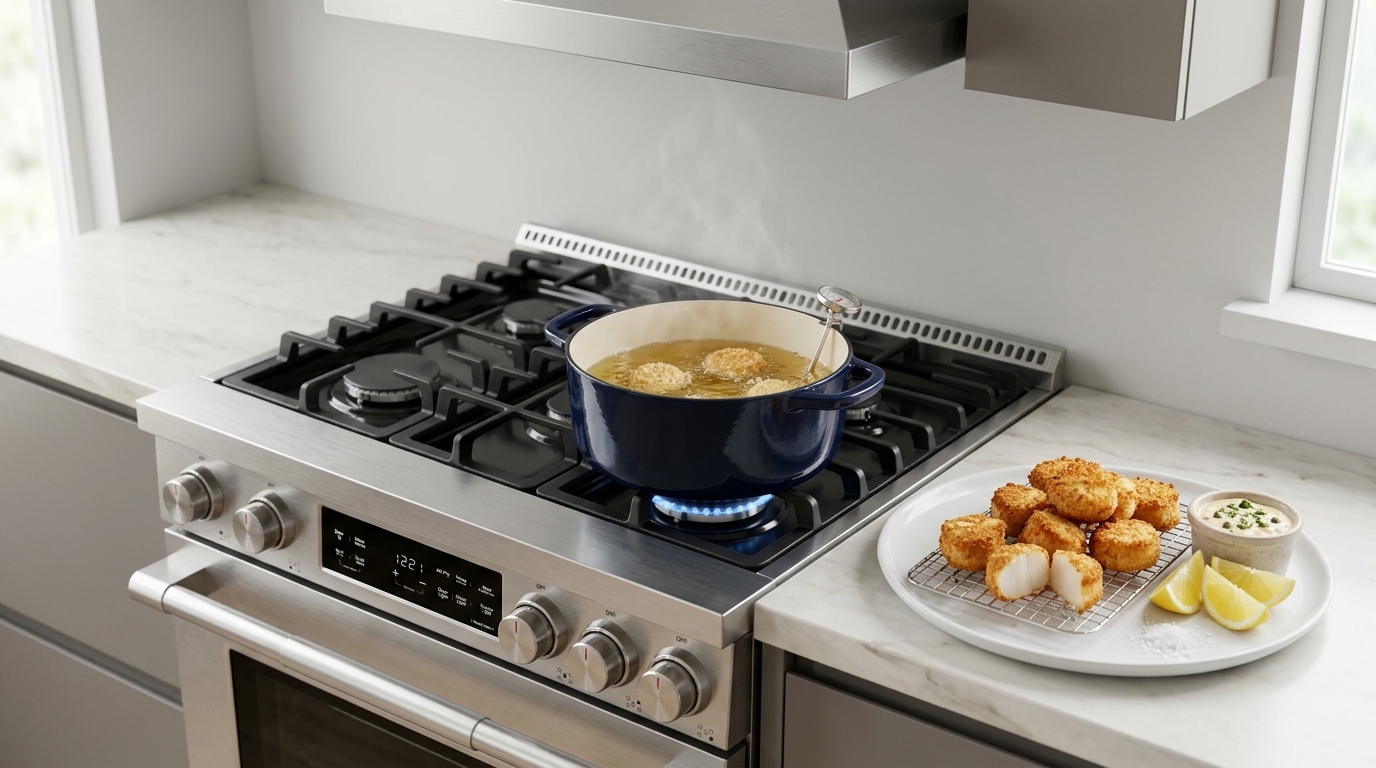
The most underrated piece of equipment is the burner itself. Each time a batch of cold scallops goes into the pot, the oil temperature drops, and the speed at which it recovers decides whether the next batch fries crisp or soaks up grease. The Cosmo COS-RGS305SS 30 inch Gas Range with 5 Burners and Convection Oven with Air Fry, one of the newest models in Cosmo’s Stellar Collection, is built for exactly this kind of cooking. Its cooktop pairs a 22,000 BTU burner with an 18,000 BTU burner, so the oil climbs back to temperature quickly between batches. Heavy duty cast iron grates hold a full Dutch oven steady, and solid metal knobs make small adjustments easy when the thermometer begins to drift. Meanwhile, its gentle 3,500 BTU burner can keep a small pan of lemon butter warm without scorching it.
Whatever stove you cook on, switch on the range hood before you begin. Frying releases steam and airborne grease, and good ventilation keeps the kitchen comfortable.
Method
- Dry the scallops. Lay the scallops in a single layer on paper towels, cover with more towels and press gently. Transfer them to a towel lined plate and refrigerate, uncovered, for 20 to 30 minutes. The cold, dry air pulls away surface moisture that paper towels miss.
- Trim the side muscle. Check each scallop for the small, tough rectangular tab that sometimes clings to one edge. It turns chewy when cooked, so pinch it off and discard it. Season the scallops on all sides with 1/2 teaspoon of the kosher salt and the black pepper.
- Set up the breading station. In the first shallow dish, whisk the flour with the Old Bay and the remaining 1/2 teaspoon salt. In the second, beat the eggs with the milk. Place the panko or cracker and cornmeal mixture in the third.
- Bread and rest. Dredge each scallop in flour and tap off the excess. Dip it in egg and let the extra drip away, then press it into the crumbs to coat every side. Set the breaded scallops on a wire rack and let them rest for 10 minutes so the coating sets and clings in the oil.
- Heat the oil. Pour about 2 inches of oil into the Dutch oven, leaving at least 3 inches of clearance below the rim. Clip on the thermometer and heat over medium high until the oil reaches 365 degrees Fahrenheit. Aim to hold it between 350 and 375 degrees for the entire cook.
- Fry in small batches. Lower five or six scallops into the oil, laying them away from you to avoid splashes. Crowding the pot drops the temperature and steams the scallops against one another. Fry sea scallops for 2 to 3 minutes, turning once, until deep golden brown. Bay scallops need only 60 to 90 seconds.
- Check for doneness. The scallops are ready when the flesh feels just firm with a slight spring. If in doubt, cut one open. The center should look opaque and milky white rather than glassy.
- Drain and season. Lift the scallops onto the second wire rack rather than paper towels, which trap steam and soften the bottom crust. Sprinkle with flaky salt while they still glisten. Keep finished batches warm in a 200 degree oven while you fry the rest, letting the oil return to 365 degrees before each new batch.
- Make the remoulade. While the oil heats or between batches, stir together the mayonnaise, Dijon, capers, parsley, lemon juice and hot sauce. Taste and adjust the seasoning.
The Air Fry Variation
Not every cook wants a pot of hot oil on a weeknight, and the Cosmo COS-RGS305SS offers a lighter route. Its 4.8 cubic foot convection oven includes a dedicated Air Fry function and comes with an air fry tray designed to circulate hot air around every side of the food.
Follow steps 1 through 4 as written. Arrange the breaded scallops in a single layer on the air fry tray, leaving space between them, and mist them lightly with oil. Air fry until the crumbs are golden and crisp, turning them once halfway through. Begin checking after five or six minutes, since scallops move from perfect to overcooked quickly, and use the same doneness test described in step 7.
The result is not identical to deep frying, but it comes remarkably close, with a crisp shell, a tender center and a fraction of the oil.
Bringing It to the Table
Fried scallops are at their best within minutes of leaving the oil, so have the table set before the first batch goes in. Pile them onto a warm platter with lemon wedges and the remoulade, or a classic tartar sauce if you prefer. Crisp coleslaw, hand cut fries or a simple green salad dressed in lemon vinaigrette round out the plate, and a chilled glass of Sauvignon Blanc or a cold lager makes a fine companion.
National Fried Scallops Day is a reminder that some of the best restaurant dishes are well within reach at home. Buy dry scallops, dry them again, keep the oil honest and give each batch room to breathe. With the right technique and a stove that can keep up, the perfect golden scallop is closer than most cooks think.