
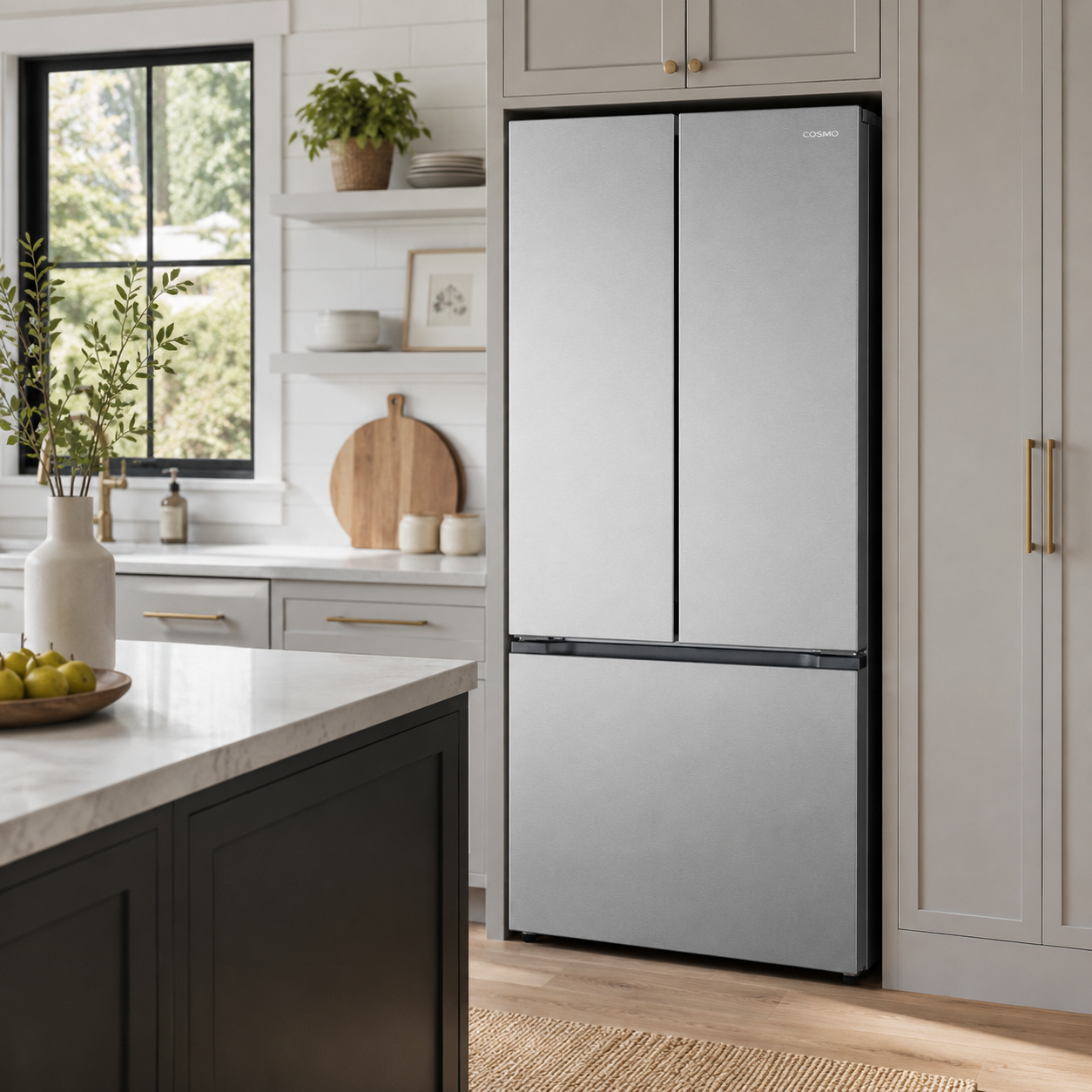
The COS-RFFV183RS French Door Refrigerator: 30-Inch with 17.5 Cu. Ft. Capacity
Not every kitchen has room for a 36-inch refrigerator, and not every household needs 22-25 cubic feet of cold storage to feel adequately equipped. The COS-RFFV183RS addresses the segment of the market that the larger French door refrigerators overlook, a genuine 30-inch width that fits standard kitchen openings without requiring cabinet modification, paired with 17.5 cubic feet of capacity that comfortably serves smaller households, secondary kitchens, condos, and any space where a full-size 36-inch refrigerator simply won’t fit.
What makes this more than a scaled-down version of a larger refrigerator is that it retains the same core feature set that makes French door refrigerators desirable in the first place. Electronic temperature controls manage refrigerator and freezer zones precisely. Adjustable shelves let you reconfigure the interior as storage needs change. LED lighting illuminates the cavity efficiently. A built-in ice maker eliminates manual tray filling. A controllable alarm setting alerts you if doors are left ajar. The French door design itself provides the same ergonomic and access advantages found in larger models, narrower door swing for tight kitchens, eye-level access to the full refrigerator section, and a bottom freezer that keeps everyday items within easy reach.
Why 30-Inch Width Matters for a Meaningful Segment of Buyers
Refrigerator width is one of the most consequential measurements in kitchen design, dictating not just whether a unit physically fits but how much surrounding cabinetry needs to accommodate it.
Standard Kitchen Openings: Many kitchens — particularly those in condos, smaller homes, older construction, and secondary residences — were built around 30 to 33-inch refrigerator openings rather than the 36-inch standard that larger French door models require. Installing a 36-inch refrigerator into a 30-inch opening means cabinet demolition and rebuilding, an expense and disruption that many buyers want to avoid. The COS-RFFV183RS fits these existing openings directly, making replacement straightforward without renovation.
Apartment and Condo Applications: Multi-family housing units consistently use smaller kitchen footprints than single-family homes, and refrigerator openings in these spaces are sized accordingly. A 30-inch French door option gives buyers in these spaces access to French door styling and functionality that was previously only available in widths too large for their kitchens, without forcing a compromise to a side-by-side or top-freezer configuration.
Secondary Kitchens: Guest houses, in-law suites, finished basements, and vacation properties often need full refrigeration without requiring the capacity of a primary household refrigerator. The COS-RFFV183RS provides genuine French door functionality at a size and capacity appropriate for these secondary spaces, where a 22+ cubic foot refrigerator would be excessive for the household size using that space.
Households of One or Two: Single-person and two-person households frequently find that larger refrigerators leave substantial unused space, particularly in the refrigerator section where food spoilage risk increases the longer items sit unused. A right-sized 17.5 cubic foot refrigerator matches storage capacity to actual consumption patterns more accurately, potentially reducing the food waste that comes from storage space exceeding realistic grocery rotation.
Proportional Kitchen Design: In smaller kitchens generally, a 36-inch refrigerator can visually dominate the space in ways that feel disproportionate to the room’s overall scale. A 30-inch refrigerator maintains better visual balance in compact kitchens, avoiding the oversized appliance feeling that occurs when refrigerator width exceeds what the surrounding kitchen proportions suggest.
French Door Design at This Scale
The French door configuration delivers the same functional advantages in the 30-inch COS-RFFV183RS that it provides in larger models, with some specific considerations relevant to the smaller footprint.
Narrower Door Swing: Each door opens to roughly half the width of a full-width single door, requiring less clearance space in front of the refrigerator than traditional single-door designs. This matters particularly in smaller kitchens where floor space is already constrained — the reduced door swing radius means the refrigerator doesn’t require as much open floor area to operate, an advantage that compounds in compact kitchen layouts.
Eye-Level Refrigerator Access: Positioning the refrigerator section at the top, accessible through both French doors, keeps the most frequently accessed storage at eye level rather than requiring bending to reach lower shelves. This ergonomic benefit applies regardless of refrigerator size, but it’s particularly valuable in smaller kitchens where users may not have alternative storage solutions to compensate for awkward refrigerator ergonomics.
Bottom Freezer Placement: The freezer section sits below the refrigerator, accessed through a pull-out drawer or door depending on the specific configuration. Bottom freezer designs keep the more frequently used refrigerator section at the more convenient height, while freezer items — generally accessed less often during a typical day — sit in the lower position.
Single Combined Cavity Efficiency: At 17.5 cubic feet total, the COS-RFFV183RS divides this capacity between refrigerator and freezer sections in proportions designed for typical household usage patterns, where refrigerated items significantly outnumber frozen items in daily consumption. This allocation makes the available capacity work harder for typical grocery and meal planning patterns rather than allocating space evenly between sections regardless of actual usage.
Electronic Temperature Controls
Precise temperature management matters as much in a 17.5 cubic foot refrigerator as it does in larger models, and the COS-RFFV183RS delivers this through the same electronic control approach found across Cosmo’s refrigerator lineup.
Digital Precision: Electronic controls allow setting exact target temperatures rather than the vague positioning that mechanical dial thermostats provide. This precision matters for food safety — maintaining the refrigerator section within the 37-40°F range that proper food preservation requires, and the freezer at 0°F for safe long-term frozen storage.
Independent Zone Management: Refrigerator and freezer sections maintain their target temperatures independently, preventing the compromise where adjusting one section’s cooling inadvertently affects the other. This independence ensures both zones operate at their respective optimal temperatures regardless of how much you’re using either section on a given day.
Consistency Through Door Openings: Electronic controls respond more quickly to temperature fluctuations from door openings than older mechanical systems, helping maintain narrower temperature ranges even as doors open and close throughout daily use. This responsiveness matters proportionally more in smaller refrigerators, where the same volume of warm air entering during a door opening represents a larger percentage of total interior air volume compared to a larger refrigerator.
Adjustable Shelving
Interior flexibility matters significantly in a 17.5 cubic foot refrigerator, where every section of available space needs to work efficiently for the items a smaller household actually stores.
Reconfigurable Storage: Glass shelves reposition at different heights to accommodate tall items — pitcher containers, large bottles, or stacked containers — without wasting vertical space designed for shorter items. In a refrigerator with less total volume than larger models, this flexibility has outsized importance for maximizing genuinely usable storage capacity.
Adapting to Changing Needs: Household storage needs shift over time — more produce during certain seasons, more prepared meal containers during busy weeks, more beverages during entertaining periods. Adjustable shelving lets the refrigerator’s interior configuration respond to these shifts rather than forcing a fixed layout that works well for some storage patterns and poorly for others.
Maximizing Available Space: In a refrigerator where total capacity is more constrained than larger models, eliminating wasted vertical space between fixed shelf positions becomes more consequential. Properly configured adjustable shelving in the COS-RFFV183RS can meaningfully increase genuinely usable storage capacity beyond what the raw cubic footage figure suggests.
Built-In Ice Maker
Automatic ice production provides the same convenience in this 30-inch model that larger refrigerators offer, without requiring manual ice tray management.
Automatic Operation: The built-in ice maker monitors ice supply and produces additional cubes automatically as needed, eliminating the need to manually fill and freeze ice trays. For households that use ice regularly — daily beverages, entertaining, or simply convenience — automatic ice production removes a small but recurring task from kitchen routines.
Space Efficiency Consideration: Built-in ice makers occupy some freezer space that would otherwise be available for food storage. In a 17.5 cubic foot refrigerator where freezer capacity is more limited than in larger models, this tradeoff is worth understanding — the convenience of automatic ice production comes at a modest cost to overall freezer storage capacity. For most households, the convenience outweighs this tradeoff, but households planning to use the freezer section intensively should factor this into their capacity planning.
LED Lighting and Door Alarm
These features support daily usability in ways that matter across refrigerator sizes, with particular relevance to smaller refrigerators where interior visibility and energy efficiency both carry proportionally greater significance.
LED Interior Illumination: LED lighting throughout the refrigerator cavity provides bright, even illumination that makes locating items straightforward, even in the corners and lower sections that benefit less from ambient kitchen lighting. LED technology consumes minimal energy while producing strong, consistent light output, and the bulbs last for years without requiring replacement.
Controllable Door Alarm: The door alarm alerts you audibly if a refrigerator or freezer door is left ajar beyond a set time threshold. This feature prevents the energy waste and food safety risk that comes from doors not closing fully — a relevant concern in any refrigerator size, but one where the controllable aspect lets households adjust sensitivity based on their own usage patterns and preferences rather than dealing with an alarm calibrated for different household behavior.
Installation Considerations for the COS-RFFV183RS
Installing a 30-inch refrigerator involves some considerations distinct from the larger French door models more commonly discussed in refrigerator buying guides.
Opening Verification: Before purchasing, measure your existing refrigerator opening carefully — width, depth, and height — to confirm the COS-RFFV183RS fits with appropriate clearance for door swing and ventilation. Standard 30-inch refrigerator openings typically provide adequate space, but older installations sometimes have non-standard dimensions worth verifying directly.
Clearance for Ventilation: Like all refrigerators, the COS-RFFV183RS requires clearance around the back and sides for proper air circulation around the condenser system. Insufficient clearance reduces cooling efficiency and increases energy consumption, so confirming adequate space during installation planning protects both performance and long-term operating costs.
Door Swing in Compact Kitchens: While French door configuration generally requires less swing clearance than single-door designs, verify that both refrigerator doors can open to a functional angle given your specific kitchen layout. In particularly tight installations, confirm that nearby cabinets, islands, or walls don’t restrict door opening to an impractical degree.
Electrical Requirements: Standard 120V household electrical service powers the COS-RFFV183RS, consistent with refrigerator electrical requirements across sizes. Most existing refrigerator installations already have appropriate electrical infrastructure in place, making replacement straightforward from an electrical standpoint.
Who This Refrigerator Actually Serves
Understanding the specific buyer profile that benefits most from the COS-RFFV183RS helps clarify whether this is the right capacity and width for a given kitchen situation.
Single Professionals and Couples: Households of one or two people generally don’t generate enough grocery volume to justify 22+ cubic feet of refrigerated storage. The COS-RFFV183RS’s 17.5 cubic feet provides ample room for typical shopping patterns without excess capacity that goes unused or leads to forgotten, spoiled food in rarely-accessed corners.
Condo and Apartment Owners: Buyers in multi-family housing frequently face refrigerator openings sized for 30-inch units as a building standard. The COS-RFFV183RS gives these buyers access to genuine French door functionality without requiring the cabinet modification that installing a wider refrigerator would demand.
Secondary Residence Owners: Vacation homes, rental properties, and guest accommodations benefit from full-featured refrigeration without the capacity that a primary residence requires. The COS-RFFV183RS provides complete functionality — automatic ice, adjustable storage, precise temperature control — at a scale appropriate for these secondary applications.
Kitchen Renovators Working Within Existing Constraints: Households renovating kitchens without modifying the existing footprint or cabinet layout often need to work within a 30-inch refrigerator opening that predates current refrigerator size trends. The COS-RFFV183RS allows these renovations to incorporate modern French door features without requiring the structural changes that upsizing to 36 inches would necessitate.
The COS-RFFV183RS demonstrates that French door functionality and modern refrigerator features don’t require the largest available footprint to deliver genuine value. For the substantial segment of buyers working within 30-inch refrigerator openings — whether due to building constraints, household size, or kitchen proportions — this model provides electronic temperature precision, adjustable storage flexibility, automatic ice production, and the ergonomic benefits of French door design at a scale that fits their actual kitchen and actual needs, without the compromise of settling for an outdated single-door or top-freezer configuration simply because the space doesn’t accommodate larger French door alternatives.