
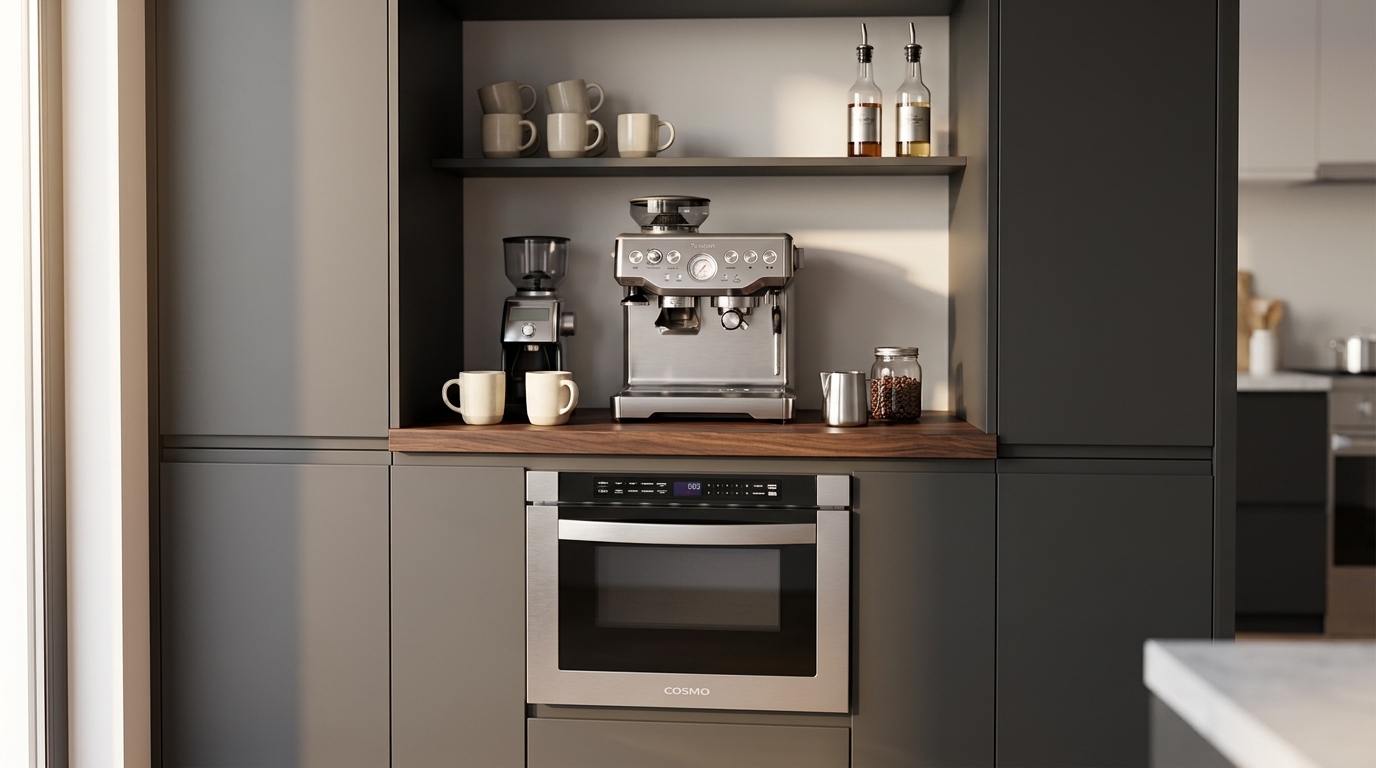
The Coffee Bar Is the New Beverage Station, and American Kitchens Are Building One On Purpose
A Trend That Followed the Beverage Station Almost Exactly
Two years ago, a homeowner drawing up kitchen plans with a designer was, more likely than not, asking for a dedicated beverage station: a built-in wine or beverage cooler, real storage for glassware, and its own footprint separate from the main cooking zone. That trend has not gone away. It has been joined by a close cousin that is showing up in renovation plans just as often, and in some 2026 trend coverage, even more so. Design outlets tracking kitchen planning for 2026 have flagged the casual coffee bar as one of the standout requests of the year, a dedicated zone built specifically around an espresso machine or pour-over setup, a grinder, open shelving to display mugs, and enough counter space to make a drink without crowding the rest of the kitchen’s morning routine.
The pattern is a familiar one. A single appliance or task used to just happen wherever there was room, a coffee maker wedged onto the counter between the toaster and the fruit bowl, and it has now graduated into its own planned zone with a name, a layout, and a line item in the renovation budget. It is the same shift that turned the wine rack into the beverage station a couple of renovation cycles ago, now playing out with coffee instead of cocktails.
What Makes a Coffee Bar Different From a Coffee Maker on the Counter
The distinction matters more than it sounds like it should. A coffee maker sitting on an otherwise ordinary stretch of counter is a convenience. A coffee bar is a small, purpose-built system, and the difference shows up in three places. First, real counter space set aside specifically for the routine, room to grind beans, steam milk, and set down a mug without shuffling aside whatever was already sitting there from the night before. Second, dedicated storage nearby, usually open shelving or glass-front cabinetry, for the mugs, filters, and syrups that otherwise end up scattered across three different cabinets. Third, and the part that gets overlooked most often, a plan for the small amount of extra equipment a coffee routine actually needs beyond the machine itself, milk for steaming, something to warm it in, a place to keep pastries that does not mean walking back across the kitchen.
That third piece is where a coffee bar most often falls short in practice. A homeowner plans the espresso machine, the grinder, and the mug shelf carefully, and then treats everything else as something to figure out later. What tends to happen instead is a coffee routine that still requires a trip to the main kitchen every single morning, to steam milk on the stovetop, to warm a pastry in the primary oven, which defeats a fair amount of the point of building a separate zone in the first place.
The One Appliance a Coffee Bar Actually Needs Beyond the Machine
A dedicated coffee bar does not need a second full kitchen behind it, and most of the households building one are not trying to install a range or a cooktop in a nook meant for espresso and pastries. What it does benefit from is a small, purpose-built way to warm milk, soften butter for the morning’s toast, and take the chill off a pastry, without pulling any of that back into the main kitchen. That is a narrower job than a full oven or a microwave built for reheating dinner, and it is exactly the kind of task a drawer-style microwave, installed directly into the cabinetry under the coffee bar counter, is built to handle.
A drawer format matters here specifically because of where a coffee bar tends to live. Most coffee nooks are built into a run of lower cabinetry along a wall, an island end cap, or a corner that was not previously doing much of anything, spaces that were not designed around counter-level appliances competing for room. A microwave drawer installs flush into that cabinetry at counter height, opening from the top rather than swinging out into the walkway the way a standard microwave door does, which keeps a small coffee nook from feeling cramped the moment someone opens it.
Where the COS-12MWDSS Fits
Cosmo’s COS-12MWDSS, a 24-inch built-in microwave drawer, was designed around exactly this kind of secondary, purpose-built installation rather than as a stand-in for a full-size kitchen microwave. It installs directly into base cabinetry at counter height, which makes it a natural fit for the lower run of cabinetry under a coffee bar counter, out of the way of the espresso machine and grinder sitting on top, and out of sight when the drawer is closed. Its 1,000-watt output and 1.2 cubic foot capacity are sized for exactly the kind of tasks a coffee bar actually needs rather than a full dinner reheat, and its touch screen control panel includes a dedicated beverage preset built specifically for warming milk and liquids to the right temperature without babysitting a stovetop pot or guessing at a manual time setting.
The rest of its preset programs do real work in a coffee bar context too. A melt and soften preset handles butter for morning toast or chocolate for a quick drizzle over a pastry without needing a double boiler or a trip to the stovetop, and weight-based defrost brings a frozen muffin or scone up to room temperature evenly rather than leaving the center cold while the edges turn rubbery. Eleven discrete power levels give a household finer control than a basic reheat button offers, useful for anything from gently melting chocolate to fully heating a breakfast sandwich without the coffee bar ever needing to double as a second kitchen. A child lock function, engaged by holding a designated button for several seconds, is a small but meaningful detail for a household with kids old enough to want their own hot chocolate from the coffee bar but not quite old enough to be left unsupervised around a hot drawer.
A Few Practical Notes for Anyone Building One
Placement should follow the same logic that makes a beverage station work: near where people actually gather in the morning, not tucked into the busiest stretch of the primary cooking zone. A coffee bar built into an underused corner or the end of an island keeps morning traffic out of the way of whoever is making breakfast at the main stove.
Counter space is worth measuring generously rather than minimally. A grinder, an espresso machine, and a mug all need room at the same time, and a coffee bar that is too tight to use both hands in ends up feeling like a compromise rather than the upgrade it was meant to be.
Open shelving works best kept genuinely light, glassware, everyday mugs, syrups in matching bottles, since the appeal of a coffee bar is largely visual and a shelf crowded with mismatched boxes and bags undercuts the whole point of giving the routine its own dedicated space.
And the appliance choice below the counter deserves the same attention as the espresso machine on top of it. A coffee bar that still requires a walk to the main kitchen to warm milk or soften butter has only solved half the problem a dedicated zone was supposed to fix.
A Small Zone Built Around a Daily Habit
What makes the coffee bar trend worth paying attention to is not that it is new in concept. Households have carved out a coffee corner in some form for years. What has changed is that it is now being planned deliberately, with its own counter space, its own storage, and its own small footprint of dedicated appliances, the same evolution that turned a wine rack into a full beverage station a couple of renovation cycles earlier. For a household building one, the Cosmo COS-12MWDSS is built for precisely the kind of quiet, out-of-the-way work a coffee bar actually needs underneath the counter, warming milk, softening butter, and bringing a pastry back to life, so the whole routine can happen in one small corner of the kitchen instead of pulling a household back into the main one every single morning.