
Popular Labor Day Recipes: What American Kitchens Are Actually Cooking This Weekend
A Holiday Built Around a Short List of Classics
Labor Day does not have the sprawling menu traditions of a Thanksgiving table or the fireworks-adjacent chaos of a Fourth of July spread. What it has instead is a tight, well-worn rotation of dishes that shows up in some form at nearly every backyard gathering across the country: burgers and hot dogs off the grill, a pot of baked beans, a bowl of pasta or potato salad, corn on the cob, and something sweet before everyone scatters for the drive home. That consistency is part of what makes Labor Day recipes worth talking about. They are not exotic, and they are not trying to be. They are the dishes a household already knows how to make well, repeated one more time before the calendar turns toward fall.
That repetition, though, is exactly what raises the stakes in the kitchen. A host cooking the same handful of crowd favorites for the third or fourth time this summer is not looking for a new recipe to learn. They are looking for the version that comes together without drama, on a stove and in an oven that can keep pace with several dishes needing different heat at once.
Burgers and Hot Dogs, Started Inside Before They Ever Touch the Grill
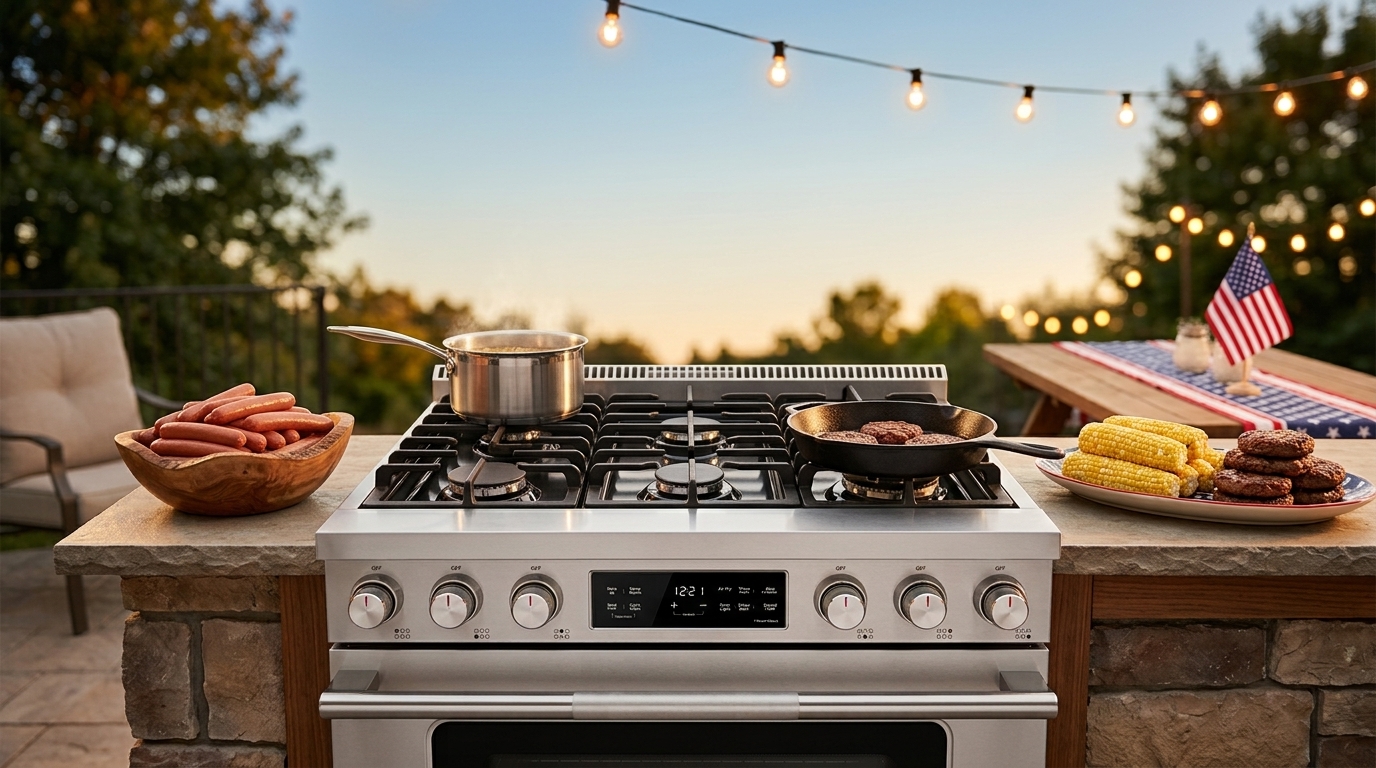
The centerpiece of most Labor Day spreads is still whatever comes off the grill, and burgers and hot dogs remain the two most reliable options for a reason: they scale easily, they please a crowd with mixed tastes, and they do not require much beyond a hot flame and a few condiments. What often gets overlooked is how much of a good burger happens before it ever reaches the grates. A smash-style patty needs a scorching hot cast iron surface to develop a real crust, and on the COS-RGS366SS, the 22,000 BTU power burner gets a cast iron griddle or skillet hot enough to crust a patty in under a minute, the difference between a smash burger with real texture and one that just steams in its own juices.
Hot dogs benefit from the same kind of attention, particularly for a household doing a Chicago-style or New York street cart version with caramelized onions folded in. Onions need a slow, patient cook to actually caramelize rather than just soften, and that is a job for one of the range’s lower-output burners, the 3,500 BTU simmer burner in particular, which holds a steady, gentle heat for as long as real caramelization takes without a host needing to hover over the pan.
Baked Beans and the Case for a Burner Built to Simmer
Few dishes say Labor Day as clearly as a pot of baked beans, and few expose the limits of an underpowered range as quickly. Beans need low, even heat sustained for a long stretch, whether finishing on the stovetop after a slow oven bake or holding at serving temperature while the rest of the meal comes together. A burner that cannot hold a true simmer forces a host to babysit the pot, stirring constantly to keep the bottom from scorching.
This is where the spread across the COS-RGS366SS’s six burners does real work. Rather than six burners tuned to roughly the same middle-of-the-road output, the range runs from that 3,500 BTU simmer burner up to a 22,000 BTU high-output burner, with two 12,000 BTU burners, an 18,000 BTU burner, and a 6,000 BTU burner filling in between. A pot of beans can hold a gentle, scorch-free simmer on the low end while a stockpot of water for corn comes to a hard boil on the high-output burner a few inches away, without either dish waiting its turn. For a menu that needs several distinct heat levels running at once, that range between burners matters more than how many burners sit on the cooktop.
Corn on the Cob, Cooked the Way the Crowd Actually Wants It
Corn on the cob is close to a Labor Day requirement, and it is also forgiving enough that it tends to get relegated to whatever burner is free rather than the one that would cook it fastest. A large stockpot of water takes a meaningfully long time to reach a hard boil on a standard mid-output burner, and for a host timing corn against burgers coming off the grill, that lag matters. The COS-RGS366SS’s 22,000 BTU burner brings a full pot to a boil dramatically faster, which keeps corn from becoming the dish that holds up the rest of the meal.
For households that prefer roasted or grilled corn, the oven’s broil setting, powered by a 13,500 BTU broil burner, gets husked ears close enough to char for real caramelization without needing outdoor grill space that is likely already occupied by burgers and hot dogs.
Pasta Salad, Potato Salad, and the Side Dishes That Round Out the Table
Every Labor Day table has its version of the cold side, whether that is a mayonnaise-based potato salad, a vinegar-forward pasta salad, or a bean and corn salad built for a warm afternoon. These dishes ask the least of the range, but they still rely on properly cooked pasta or potatoes as their foundation, and undercooked or mushy starch is the most common way a good side salad goes wrong. A burner capable of holding a full rolling boil, rather than one that dies down the moment a pot of pasta or potatoes goes in, keeps cook times predictable, which matters when a side needs to be done, cooled, and dressed well before guests arrive. The oven’s 6.1 cubic foot cavity earns its keep here too: a tray of roasted potatoes for a warm potato salad, or a pan of cornbread to sit beside the beans, can bake alongside ribs or a casserole rather than waiting for oven space to free up, since two rack positions give a host room to run more than one dish at the same temperature at once.
Ribs and Pulled Pork, When the Menu Goes Beyond the Grill Basics
A growing number of Labor Day hosts treat the holiday as the season’s last real opportunity for a low-and-slow centerpiece like ribs or pulled pork, dishes that reward patience more than any quick-grilled option does. Ribs finished with a low oven bake before a final char on the grill need hours at a steady, moderate temperature, and the COS-RGS366SS’s convection setting, powered by an 18,500 BTU bake burner, circulates heat evenly enough that a full tray finishes consistently from edge to center rather than drying out at the corners while the middle lags behind. The same holds for pulled pork done entirely in the oven: a shoulder roast held at a steady low temperature for several hours breaks down much the way it would on a smoker, and the 6.1 cubic foot cavity comfortably fits a large cut alongside a second dish.
Dessert, and the One Dish That Should Never Be an Afterthought
Dessert on a Labor Day table tends to be the dish planned last and executed under the most time pressure, usually a cobbler, a sheet cake, or a batch of bars going into the oven somewhere between the ribs coming out and the corn hitting the table. A range that holds a precise, steady baking temperature while everything else has been running hard all afternoon is what keeps dessert from getting rushed or forgotten. The digital display and delay start function on the COS-RGS366SS let a host set a cobbler to begin baking at a specific time without interrupting whatever is happening on the stovetop, and the air fry function handles a tray of cinnamon-sugar dough bites or a quick reheat of leftover pie without pulling out a separate countertop appliance that likely has no counter space left by then.
One Menu, Several Heat Zones, One Range Built to Run All of Them
What makes Labor Day cooking distinct from an ordinary weeknight dinner is not any single dish above. It is that most of these dishes happen at the same time, on the same afternoon, competing for the same stovetop and oven a household uses for far simpler meals the rest of the year. Baked beans need a gentle simmer. Corn needs a hard, fast boil. Ribs need hours of steady heat. Dessert needs a precise bake window that does not get pushed back because the oven is already occupied. A range asked to do all of that at once needs more than a high burner count; it needs real range between its burners and an oven built to run more than one dish at a time.
The Cosmo COS-RGS366SS, a 36-inch, six-burner gas range from the Stellar Collection, is built around exactly that kind of spread, from a 3,500 BTU simmer burner to a 22,000 BTU power burner, paired with a 6.1 cubic foot convection oven with two rack positions. For a holiday weekend where the kitchen is being asked to produce burgers, beans, corn, ribs, and dessert without any one dish holding up the rest, that is the kind of range built for the way Labor Day actually gets cooked.