
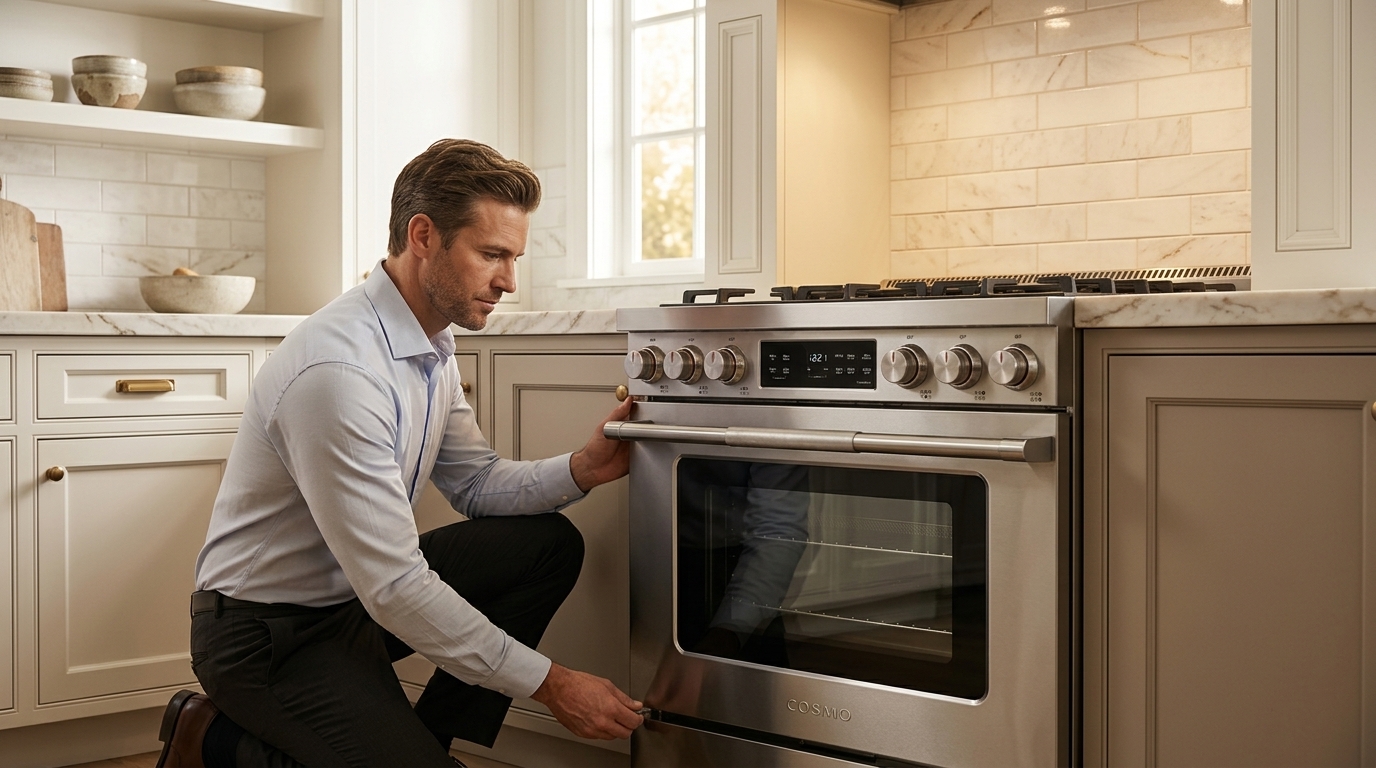
Keeping the COS-RGS366SS Running Right: A Homeowner’s Guide to Care, Cleaning, and Common Fixes
A gas range is one of the few kitchen appliances a household actually leans on every single day, which means it is also one of the appliances most likely to develop a small quirk that gets ignored until it becomes a real problem. A burner that lights a little slower than it used to. A grate that looks dull no matter how it is scrubbed. An oven that seems to run a few degrees warmer on one side than the other. None of these are dramatic failures, and none of them typically require a service call. More often, they are the kind of thing a homeowner can understand and resolve in a few minutes once they know what is actually happening underneath the range’s stainless steel exterior.
Cosmo’s COS-RGS366SS, a 36-inch, six-burner gas range from the Stellar Collection, is built with straightforward maintenance in mind, from removable cast iron grates to a steam clean function designed to cut down on manual scrubbing. But like any appliance that combines an open flame, a digital control board, and a full-size convection oven, it rewards an owner who understands the basics of how it works. This guide walks through the most common questions and small issues that come up with a range like this one, and what is actually going on when they happen.
Why a Burner Clicks but Does Not Light
The single most common concern range owners report is a burner that clicks repeatedly when a knob is turned but takes several seconds, or several attempts, to actually ignite. In most cases, this has nothing to do with the gas supply and everything to do with the igniter itself, the small electrode near each burner head that produces the spark. Food debris, boiled-over liquid, or general grease buildup around the burner cap and igniter tip is by far the most frequent cause, since even a thin film of residue can interrupt the spark’s path to the gas. Wiping down each burner cap and the ceramic igniter with a dry cloth, and confirming the igniter tip is completely dry after any wet cleaning, resolves the vast majority of slow-light or no-light complaints without ever needing a technician.
It is worth checking each burner individually rather than assuming a slow-lighting burner is a sign something is wrong with the range as a whole. The COS-RGS366SS spreads its six burners across a wide output range, from a 3,500 BTU simmer burner up to a 22,000 BTU high-output burner, and each has its own igniter and burner cap. A single sluggish burner is almost always a localized cleaning issue rather than anything affecting the range’s gas supply or electrical system.
Reading the Flame: What Color Actually Means
A gas burner’s flame color is one of the simplest diagnostic tools built into the range, and it is one most homeowners never learn to read. A properly functioning burner produces a flame that is almost entirely blue, with perhaps a small, steady tip of yellow at the very peak. That blue color indicates complete combustion, meaning the burner is getting the correct ratio of gas and air. A flame that burns consistently yellow or orange along most of its length, or that looks uneven around the burner ring, usually points to a burner cap that is not seated correctly or is clogged with debris, restricting the air the flame needs to burn cleanly.
The fix is almost always mechanical rather than technical. Removing the burner cap, confirming it is free of food residue in its ports, and reseating it so it sits flush and level on the burner base resolves an off-color flame in the overwhelming majority of cases. If a flame remains yellow or uneven after a burner cap has been cleaned and correctly reseated, that is one of the few situations on this list actually worth a call to a qualified technician, since it can indicate an issue with the gas-air mixture that goes beyond routine cleaning.
Why the Grates Look Dull No Matter How Often They Are Cleaned
The COS-RGS366SS uses heavy-duty cast iron grates, chosen specifically because they hold up to boiled-over pots, spattered grease, and the kind of daily wear a six-burner range sees in an active kitchen without warping or losing structural integrity. Cast iron, however, behaves differently than the stainless steel surrounding it, and a lot of the frustration owners report with dull or slightly rough-looking grates comes from cleaning them as though they were stainless steel rather than cast iron.
Cast iron grates generally do best with warm soapy water and a non-abrasive brush, dried thoroughly and promptly to prevent surface rust, rather than being left wet in a sink or run through a dishwasher cycle, which can strip their protective coating over time. A grate that looks matte or slightly gray after cleaning is not necessarily damaged. That is often just the natural surface texture of cast iron reasserting itself once grease buildup has been removed, and a light coating of cooking oil wiped on and off after drying can restore a more even, seasoned appearance. What actually warrants attention is a grate with visible cracking, chipping, or a leg that no longer sits level on the burner base, since any of those affect how a pot sits and how evenly a burner’s heat reaches it.
Knowing What Is a Homeowner Fix and What Is Not
Most of what comes up with a well-built range over years of regular use falls into the categories above: cleaning, seating a part correctly, and understanding what a feature is actually built to do. The COS-RGS366SS is also built with its own safeguards for the situations that fall outside routine maintenance, including an oven cavity cooling ventilation system, overheating protection, and a cool-to-touch handle design, all of which are there to keep the range operating safely even when something does need attention.
The general rule worth keeping in mind is that anything resolved by cleaning, reseating a burner cap or grate, or adjusting how a feature is used is squarely in homeowner territory. Anything involving the gas line itself, the range’s electrical connection, or a flame and ignition issue that persists after cleaning and reseating are the situations worth a qualified technician rather than continued troubleshooting, and the range’s one-year warranty, along with the installation guide and user manual available on its product page, are the right first stop for anything that falls into that second category.
A Range That Rewards a Little Understanding
None of this requires a homeowner to become an appliance technician. It requires knowing that a slow-lighting burner is usually a cleaning problem, that cast iron grates want different care than stainless steel, that steam clean works best on a regular schedule rather than as a rescue mission, and that a little routine attention is what keeps a six-burner range performing the way it did on day one. For anyone who already owns the Cosmo COS-RGS366SS, or is considering one, that combination of genuine cooking performance and straightforward, homeowner-manageable upkeep is a large part of what makes a range worth keeping for the long run rather than replacing at the first sign of a quirk.