
The Vanishing Kitchen: Why 2026’s Best-Designed Homes Are Hiding Their Hardest-Working Appliances
For most of the last decade, a kitchen appliance’s design job was to be seen. A statement range, a glass-front refrigerator, a bank of touchscreens across the counter, all of it built to announce itself the moment someone walked into the room. Heading into the back half of 2026, a quieter and, in a lot of ways, more demanding design standard has taken over. The best kitchens this year are not the ones with the most visible technology. They are the ones where the hardest-working appliances disappear entirely, tucked behind flush panels, hidden control strips, and cabinetry built specifically so the kitchen looks composed whether or not anyone just finished cooking in it.
A Trend About What a Kitchen Does Not Show
Design coverage tracking 2026 kitchens keeps circling back to the same idea from different directions. Some of it gets filed under “quiet luxury,” an approach that favors understated materials and craftsmanship over anything that reads as a statement piece, with designers advising homeowners to “clear worktops of clutter, store appliances out of sight where possible, and let your beautiful materials breathe.” Other coverage calls it “hidden function,” a more architectural version of the same instinct: build the kitchen so that daily mess has a designated home, rather than relying on a household’s discipline to keep counters clear after every meal. The specific vocabulary varies. The underlying behavior does not. Homeowners renovating in 2026 are asking designers, consistently, for a kitchen that looks calm by default, not one that only looks calm right after it has been cleaned.
That is a real shift from where kitchen design was sitting even a few years ago, when a visible, feature-forward appliance was treated as the reward for a successful renovation. A kitchen island built around a dramatic hood, a refrigerator with a screen bolted to the door, a dishwasher with a blinking control panel facing straight into the dining room: all of it was, until recently, evidence that a household had upgraded. In 2026, that same visible technology increasingly reads as noise rather than achievement. The appliance a homeowner is proudest of now is often the one a guest would not notice unless they were told where to look.
Why This Is Happening Now, Specifically
A few things are converging to push this trend past a design-magazine talking point and into actual renovation requests. Open-concept living is a large part of it. A kitchen that opens directly into a living or dining space is visible constantly, not just during a dinner party, and a control panel or a cluttered counter that would have been forgivable in a closed-off kitchen a generation ago is now on display around the clock. A kitchen built to be looked at all day has a very different design standard than one that only had to look good for company.
There is also a fatigue factor working in the same direction. Households that spent the last several renovation cycles adding visible technology, touchscreens, app-connected displays, blinking indicator lights, have started reporting the opposite instinct: a desire for surfaces that stay quiet unless something actually needs attention. A control panel that lights up and beeps every time a cycle starts is a feature a household notices for the first month and tunes out, or resents, for the years after. Designers describing this shift point specifically to hardware and material choices doing more of the visual work now, matte finishes, natural stone, understated cabinet pulls, precisely because they do not compete for attention the way a screen or a bank of buttons does.
Where a Dishwasher Actually Fits Into This
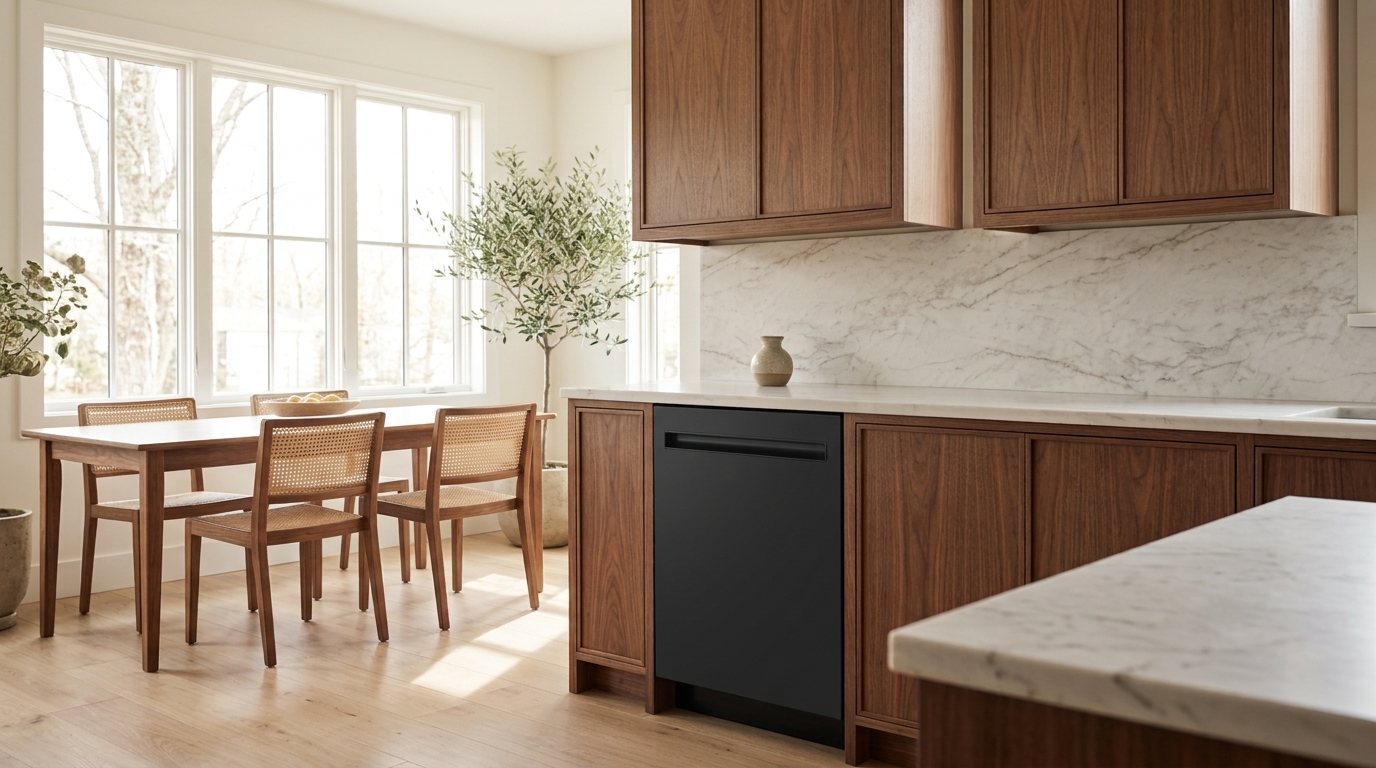
Of every appliance in a kitchen, the dishwasher has the hardest job to hide. A range gets used for an hour at dinner and then closes. A refrigerator’s door faces one direction. A dishwasher, by contrast, sits at counter height, typically along the most visible run of cabinetry in the room, and its control panel has traditionally been the one thing on the front of a kitchen that is never fully turned off, a lit display, a row of buttons, a status light cycling through a wash. For a kitchen trying to read as calm and composed at every hour, that is a genuine design problem, not a minor one.
This is exactly the gap Cosmo’s COS-DWI240TTRBK, a 24-inch built-in dishwasher, was built to close. Its controls sit on top of the door rather than the front, a soft-touch panel with an LED display that stays completely hidden the moment the door swings shut, which means the appliance that runs longest and most visibly in a typical kitchen contributes nothing to the counter-level clutter a household is trying to eliminate. In place of a blinking front panel, a small FloorGlow indicator projects a subtle light onto the floor to show a cycle is running, informative without putting a display back on the front of the kitchen. A recessed door handle continues the same idea at the hardware level, keeping the unit’s face as close to a flush, uninterrupted line of cabinetry as a dishwasher can get.
The rest of the unit backs up that visual restraint with real performance rather than trading one for the other. Eight wash cycles, including a dedicated Crystal Care setting for glassware and a Zone Wash option for heavily soiled cookware, run through a three-rack system with stemware holders and a silverware basket, giving a 15-place-setting capacity enough flexibility that a household can run fewer, fuller loads rather than constantly cycling a half-empty machine. An Auto Open Dry function pops the door slightly at the end of a cycle to let steam escape and dishes finish drying passively, without a heating element running longer than it needs to, and NSF-certified sanitize technology handles a 99.99 percent bacteria reduction cycle for cutting boards, baby bottles, or anything else that needs more than a standard wash. An Energy Star rating keeps the unit efficient on top of all of it, and the whole thing runs at 45 decibels, quiet enough that its presence in an open kitchen is felt even less than its hidden controls would suggest.
A Few Practical Notes for Anyone Chasing This Look
Concealment only works if it does not come at the cost of usability a household actually needs day to day. A hidden control panel is worth it when the controls underneath are still intuitive once the door is open; it stops being worth it if a household has to guess at settings every time they run a cycle.
Pair appliance-level concealment with a genuine dedicated spot for the things that generate daily clutter. A dishwasher that disappears into the cabinetry solves one problem, but a counter still covered in mail, chargers, and yesterday’s mug undercuts the same goal from a different direction. The households getting the most out of this trend tend to plan both at once, rather than assuming a quieter appliance alone will do the work.
Recessed and integrated hardware, door handles, drawer pulls, control strips, reads as more expensive than it costs to add, largely because it signals that a kitchen was planned as a whole rather than assembled appliance by appliance. It is one of the more cost-effective ways to buy into this trend without a full renovation.
And do not confuse quiet design with a lack of capability. The appliances driving this trend are not stripped-down or basic; the COS-DWI240TTRBK’s eight cycles and sanitize technology are proof the visual restraint is a design choice layered on top of real performance, not a substitute for it.
A Kitchen Built to Be Lived In, Not Managed
What makes this shift worth paying attention to is that it is not really about hiding technology for its own sake. It is a response to a kitchen that is visible more hours of the day than it used to be, and a growing sense among homeowners that a room does not have to announce every appliance in it to feel finished. The best-reviewed kitchens of 2026 are not the ones with the least capability. They are the ones where that capability sits quietly behind a flush panel, a recessed handle, and a control strip that stays dark until it is actually needed. A dishwasher like the COS-DWI240TTRBK is built around exactly that idea: real capability, kept out of sight until the moment it is doing its job.