
What Belongs in Your Dishwasher, What Doesn’t, and How to Load the Rest
Most kitchens run on an unspoken rule: if it is dirty and it fits, it goes in the dishwasher. The rule works right up until a wooden spoon comes out fuzzy, a favorite pan comes out dull, or a good knife loses its edge. Dishwashers are built to clean a specific range of materials extremely well, and they are also hot, wet, and mildly abrasive environments that some cookware was never designed to survive.
Knowing where that line sits does two things. It protects the items that would be damaged, and it lets you fill the machine with the things it is best at, so every cycle earns its water and energy. Sorting a load takes about a minute. Here is how to think through it.
Why Some Items Do Not Survive the Cycle
A dishwasher combines three things that are hard on certain materials: sustained heat, strong detergent, and long exposure to water. Detergent is formulated to break down grease and starch, which makes it alkaline, and that chemistry is exactly what dulls, strips, or discolors some finishes. Heat can warp thin plastic, loosen glued handles, and dry out natural materials until they crack.
The lesson is not that the dishwasher is harsh. It is that different materials react differently, and the damage is usually gradual. An item that comes out looking fine after one cycle can look noticeably worse after twenty.
What Should Stay Out of the Dishwasher
A short list covers most of the trouble. Cast iron is the classic example. The dishwasher strips the seasoning that makes a skillet nonstick, and standing water invites rust. Wooden spoons, boards, and bowls swell and split under heat and moisture. Sharp knives are best washed by hand, both because the detergent and jostling can dull the edge and because loose blades in a rack are a hazard when someone reaches in to unload.
Nonstick pans deserve caution too. Many manufacturers recommend hand washing, since repeated exposure to strong detergent can wear down the coating over time. Non-anodized aluminum tends to darken and pit, and copper can tarnish. That includes aluminum baking sheets, which often come out dull or discolored and can warp when they cycle through heat repeatedly. A quick wash by hand is gentler and takes less time than it seems.
Delicate items belong on the same list: hand-painted or gold-rimmed china, fine crystal, and anything glued together. Insulated tumblers and travel mugs vary widely, so it is worth checking the bottom of the item or the manufacturer’s care guidance before assuming they are safe. When something has no label and real sentimental or dollar value, the safest choice is the sink.
What the Dishwasher Does Best
The other side of the ledger is long, and it covers most of what a household actually uses every day. Everyday plates, bowls, and mugs. Drinking glasses. Stainless steel flatware and utensils. Stainless steel pots and pans, which handle heat and detergent well. Tempered glass and ceramic bakeware, including casserole dishes, as long as the label says dishwasher safe. Plastic containers and food storage marked dishwasher safe. Plastic cutting boards. Baby bottles and their parts, where a hot, sanitizing cycle is a real advantage over a sponge.
These are the items that benefit most from a dishwasher’s combination of high water temperature and consistent water pressure. A machine reaches temperatures most people would not tolerate at a sink, and it does so the same way every time, which is difficult to replicate by hand.
Loading the Rest for Better Results
Once the load is sorted, how it is arranged matters as much as what is in it. Water needs to reach every soiled surface, and spray arms need room to turn.
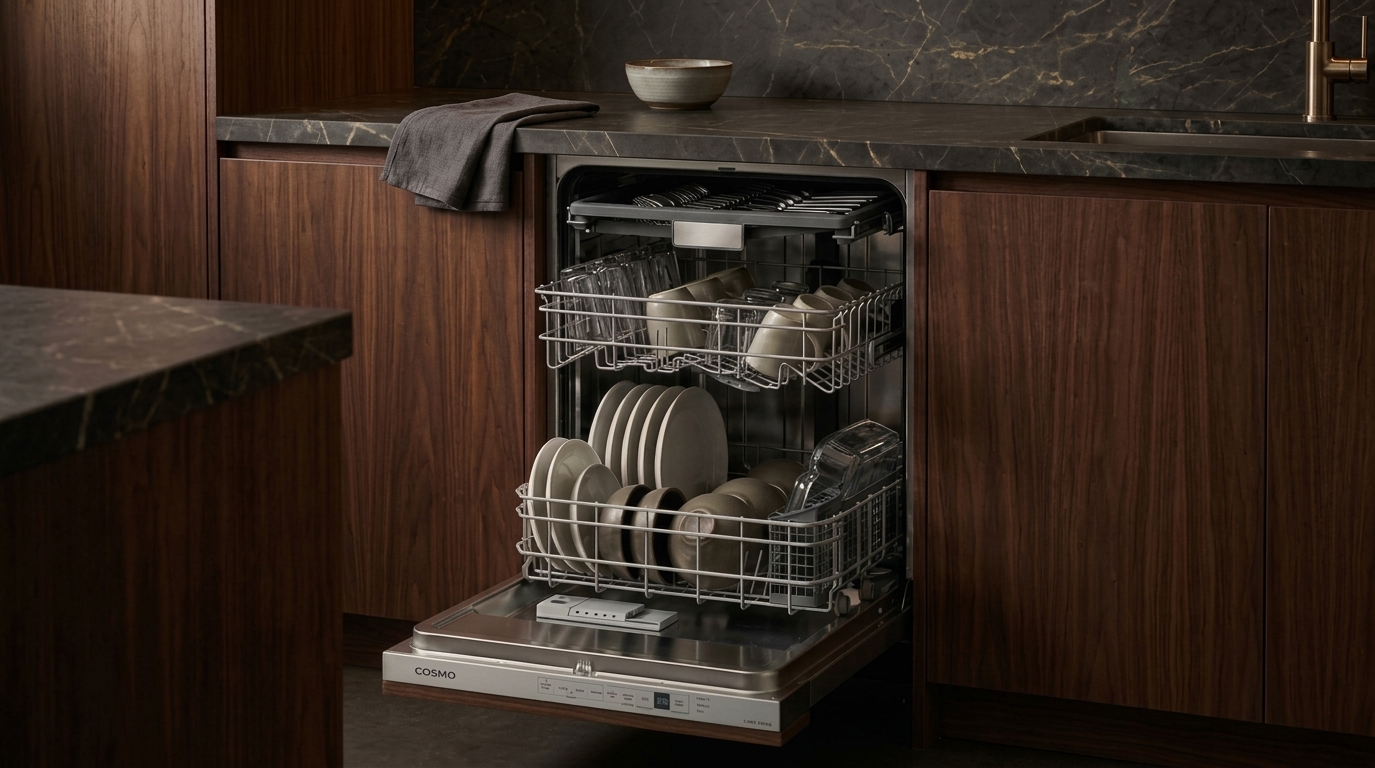
Plates and bowls belong on the bottom rack, angled slightly downward and facing the center where the spray is strongest. Leave a little space between pieces rather than stacking them, since dishes pressed together shield each other from water. Bowls and mugs go upside down so they drain rather than fill. Cups, glasses, and plastic containers belong on the top rack, where they sit farther from the heating element and are less likely to warp. Silverware goes in the basket, ideally mixed so that spoons do not nest together, with handles down for most pieces and sharp-tipped items pointed away from anyone unloading.
Before closing the door, spin the lower spray arm by hand. If a tall dish or a handle catches it, adjust the load. It is a ten-second check that prevents most poor results.
Scrape, Do Not Rinse
One of the most common habits is also one of the least useful: rinsing dishes thoroughly before loading them. ENERGY STAR guidance advises scraping food off rather than pre-rinsing, noting that rinsing adds to total water and energy use, and it recommends running full loads. Modern detergents also rely on some food residue to work properly, so a nearly clean dish can end up with less to grab onto.
Scrape off chunks, pooled grease, and anything thick, and leave the film. For a dish with residue that has dried hard, a short soak in warm water loosens it far more effectively than scrubbing.
Where the COS-DWV24TTR Fits
A dishwasher makes sorting easier when it has room to handle everything that belongs inside it. The COS-DWV24TTR, part of Cosmo’s Vista Collection, is a 24-inch built-in with a tall tub and capacity for up to 16 place settings. Three racks and a silverware basket give a household space to separate items sensibly, with dishes below, glasses and plastics above, and utensils in the basket, rather than crowding everything into whatever gap is left.
The COS-DWV24TTR offers four wash cycles, Normal, Auto, Heavy, and Express, along with Sanitize, Rapid Heated Dry, and Delay Start options. Normal handles an ordinary evening, Auto adjusts to a mixed load, and Heavy is the setting for casserole dishes and stainless pots with baked-on residue. The Sanitize option, rated for 99.99 percent bacteria reduction, is a sensible choice for plastic cutting boards, baby bottles, and other items that come into contact with raw food or need more than a standard wash.
Its stainless steel tub is designed to resist odors, which helps between loads, and an anti-leak detection system and child safety lock add peace of mind for busy households. It is Energy Star certified, and at 48 decibels it is quiet enough to run in the evening, even in a kitchen that opens onto the living room. The controls sit on a hidden soft-touch panel along the top of the door, and the recessed handle and fingerprint-resistant stainless steel finish keep the front of the kitchen tidy.
A Simple Habit for Every Load
A well-sorted dishwasher load comes down to a few habits. Check the label or the manufacturer’s guidance when an item is new. Wash hand-wash items right away rather than letting them pile up, since a hand-wash stack that sits for days is how items end up in the dishwasher out of convenience. Run full loads, since a full machine uses water and energy more efficiently than a half-empty one. And keep the machine itself in good shape by checking the filter every few weeks and wiping around the door gasket.
A short sorting routine near the sink helps. Keep a small drying rack or a folded towel where hand-wash pieces can go as they are used, so the decision is made at the sink rather than at the rack. Over time it becomes automatic, and the dishwasher only sees what it was built to clean.
Let the Machine Do What It Does Best
A dishwasher is one of the most efficient tools in the kitchen when it is used for the right things. Sorting takes a minute, protects the cookware worth protecting, and keeps every cycle focused on the items that benefit most. A dishwasher like the COS-DWV24TTR pairs generous capacity, flexible racks, and dependable cycles with quiet operation, so the everyday load, sorted sensibly, comes out clean without a second thought.